












Karno is a freelance writer and a failed marathon runner who lives in Delhi. He occasionally runs a bookstore. But he does not compare himself to the character played by the handsome Hugh Grant, the quaint bookstore owner from the iconic Hollywood movie Notting Hill, with whom the actress played by the beautiful Julia Roberts falls in love. Nor with Milkha Singh, the legendary Indian sprinter also known as The Flying Sikh, when he decides to chase a thief through the dusty lanes of Daryaganj.
He is what you can call just another upper-middle-class educated man who loves the good things in life but is content with a “mid-range” mobile phone. He has good taste in music. He listens to Jim Morrison and David Bowie and craves Blue Tokai coffee. The other characters in the novel listen to Phil Collins and John Coltrane. They read David Foster Wallace and James Baldwin; they watch Ingmar Bergman films. They have long, writerly conversations over cold coffee at the Coffee House. They engage in enthusiastic debates about people living in hiding, in the forests of Chhattisgarh, beer in hand. You get the drift.
A speculative mess
In Sayantan Ghosh’s debut novel Lonely People Meet, Karno dreams of meeting a girl who might fix the emptiness in his life – someone to fool around with, someone to have “stimulating conversations with in the middle of the night after watching Jordan Peele’s latest film.” These thoughts run through his mind as he chases the thief who snatches Devaki’s tote bag stamped with Shakespeare and Company. Such familiar cultural markers hint at brilliance. With that hope, I went into the book.
Unfortunately, no matter how hard I try to romanticise Karno and Devika’s relationship, the feeling – if there is even a trace of it – completely escaped me. Not even the relationship of convenience between Charlotte Lucas and William Collins in Jane Austen’s Pride and Prejudice feels as devoid of emotion. Karno, Devaki, and Faiza all quote James Baldwin, a choice that often feels forced and inconsistent with their individual sensibilities. Karno’s familiarity with Baldwin is believable; Faiza’s casual citation during a birthday gathering is not. The frequent convergence of their voices undermines their credibility.
Even though I tried to immerse myself fully in the story, I struggled to feel any emotional connection with the characters. The narrative never fully drew me in, and I found it hard to connect with any of the protagonists, except the younger Karno on whom the story’s emotional weight rests. Fourteen-year-old Karno travels with his parents to Darjeeling, where they plan to gently break the news of their impending divorce. This moment promised to be a turning point in the novel, but it falls short. The moment loses impact, as his teenage voice mirrors that of the adult narrator.
Just as I was beginning to accept the “romance” between the protagonists, the story abruptly veers into yet another twist: an alternate reality. I was dumbfounded at how effortlessly Karno got duped into missing such a crucial detail about Devaki.
Lonely People Meet introduces a promising cast – Karno, Devaki, Faiza, Suchitra, Asim, Mala, Ananda, Suneeta. But their potential is smothered by clichés and forced quotations by famous writers. Ghosh’s ambition to craft an evocative speculative tale feels emotionally hollowed out. Every character drifts through the novel in a haze of self-doubt, never achieving clarity. Even Faiza, who initially promised depth as Devaki’s articulate professor-cum-lover, soon collapses into the same confusion that defines the rest of the cast. By the end, even her agenda begins to feel uncertain.
When Karno goes on a date with Suchitra and they get drunk, his mind remains strangely lucid, drifting into sharp, philosophical reflections that feels at odds with his inebriated state. Karno’s political views seemed irrelevant to the plot, yet his reaction to a Deendayal Upadhyaya statue halfway through the novel – seeing him as a Hindutva sympathiser – makes his already unclear character even more confusing.
About a third of the way in, I began to notice a few thoughtful lines free of Karno’s bragging, and I hoped they would draw me back in. Unfortunately, that did not happen either.
Leans on philosophy, but falls flat
An engaging moment comes from Ananda Reza Chowdhury, the prolific novelist whom Karno admires. Ananda quickly emerges as an intriguing figure. But these scenes are repeatedly weakened by Karno’s muddled talk and his constant need to impress himself with how much he knows.
In one of the scenes, he notices Ananda staring at The Kiss, a well-known self-portrait by Édouard Vuillard, and immediately drifts into an unnecessary mental lecture about the painting’s history. The novel is filled with moments where Karno slips into long, aimless thoughts. Even in the ICU, while visiting his mother after her accident, he looks at the white bandage around her head and suddenly thinks of a popular detergent advertisement. These reflections could have added depth, but they do not. When the reader is already struggling to piece the story together, the constant detours only make it harder.
Even Devaki becomes tiresome with her endless chatter about life and philosophy. In its later sections, Lonely People Meet feels more like a series of contemplative editorials than a cohesive novel, pondering the woes of the world and their significance. Although some of the sentences are riveting and meaningful when read in isolation, they do not help the novel’s plot. As the protagonist, Karno inadvertently becomes his story’s stumbling block, preventing the novel from fully realising its potential.
Lonely People Meet feels overly formulaic, never managing to go past its predictable patterns, and never fully exudes the emotional vitality that its premise offers. The imagined scenes could have been compelling on their own, but their fusion produces an uneven narrative that leaves its viewers confused. As I turned the last pages of this book, I recalled a line that I had read on an earlier page. “Karno was like that novel – neither fully literary nor devotedly commercial – lost somewhere in the midlist.” This novel tries to be literary, commercial, speculative, philosophical, poetic, political, funny all at the same time – but struggles to land smoothly anywhere. Ironically, only the epilogue kept me hooked.
Also read: ‘Urban wandering is central to my writing and how I live’: Debut novelist and editor Sayantan Ghosh
Diya Sengupta works in Strategy and Consulting. She is the founder and co-curator of Juhu Reads and the co-curator of Pint of View Mumbai.
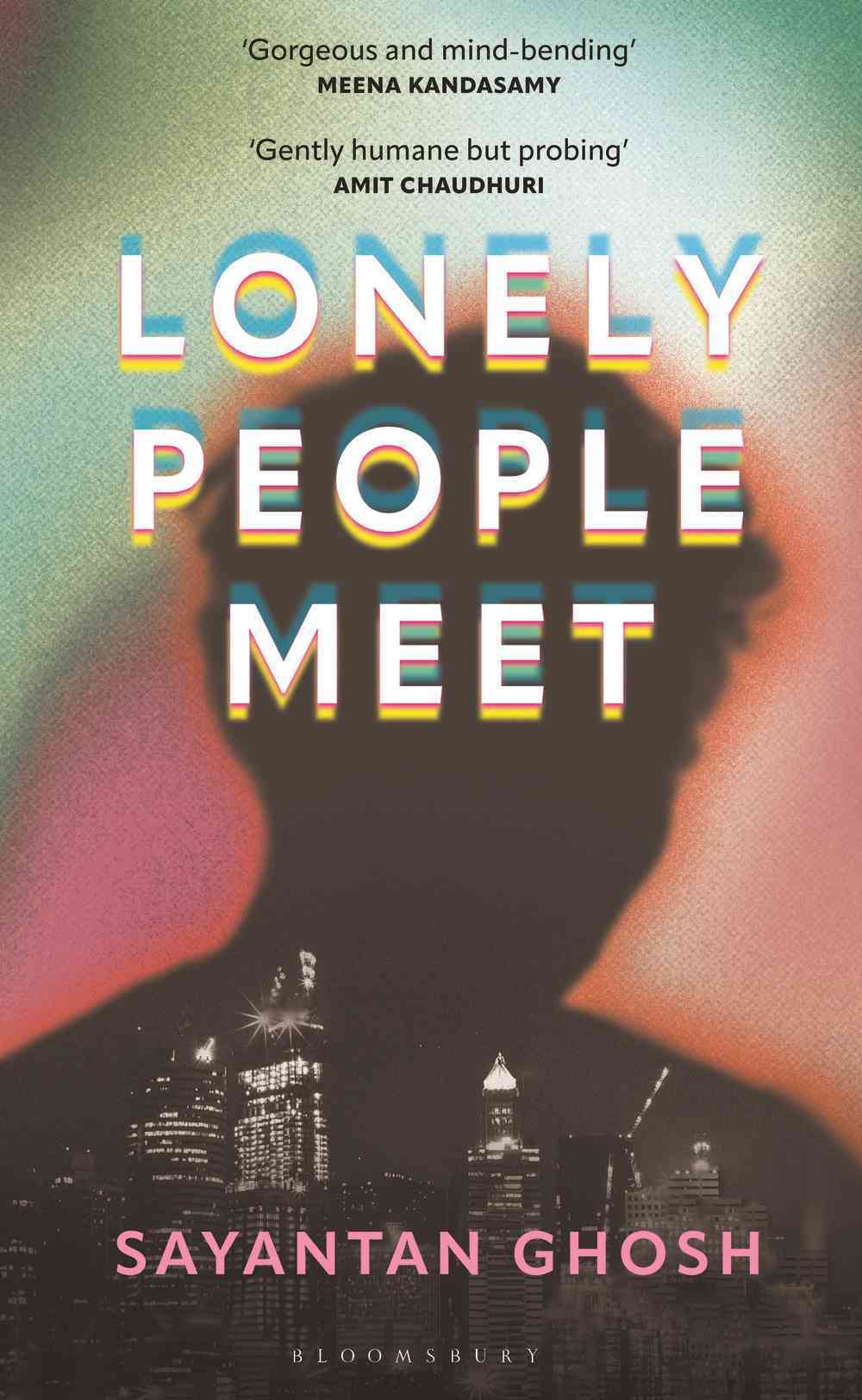
Lonely People Meet, Sayantan Ghosh, Bloomsbury India.
